
What is Secondary Contract Packaging/Co-Packing and how does it fit in the manufacturing arena?
Secondary Co-Packing Workflow
- Upstream Primary Sealed Goods: The product cycle originates with raw goods processed at an outside primary manufacturing plant. The product is sealed into its primary packaging (pouches, inner bags, cans, tubes) before transport to eliminate any risk of exposed allergens or food contamination.
- Inbound Material Consolidation: The secondary co-packer’s project coordinator team works with the customer to determine what finished goods need to go to which retail channel – and when, how, where. The co-packer receives and catalogs in the customer-owned sealed primary goods and the accompanying custom flat-packed retail boxes, corrugated trays, graphics and other key materials.
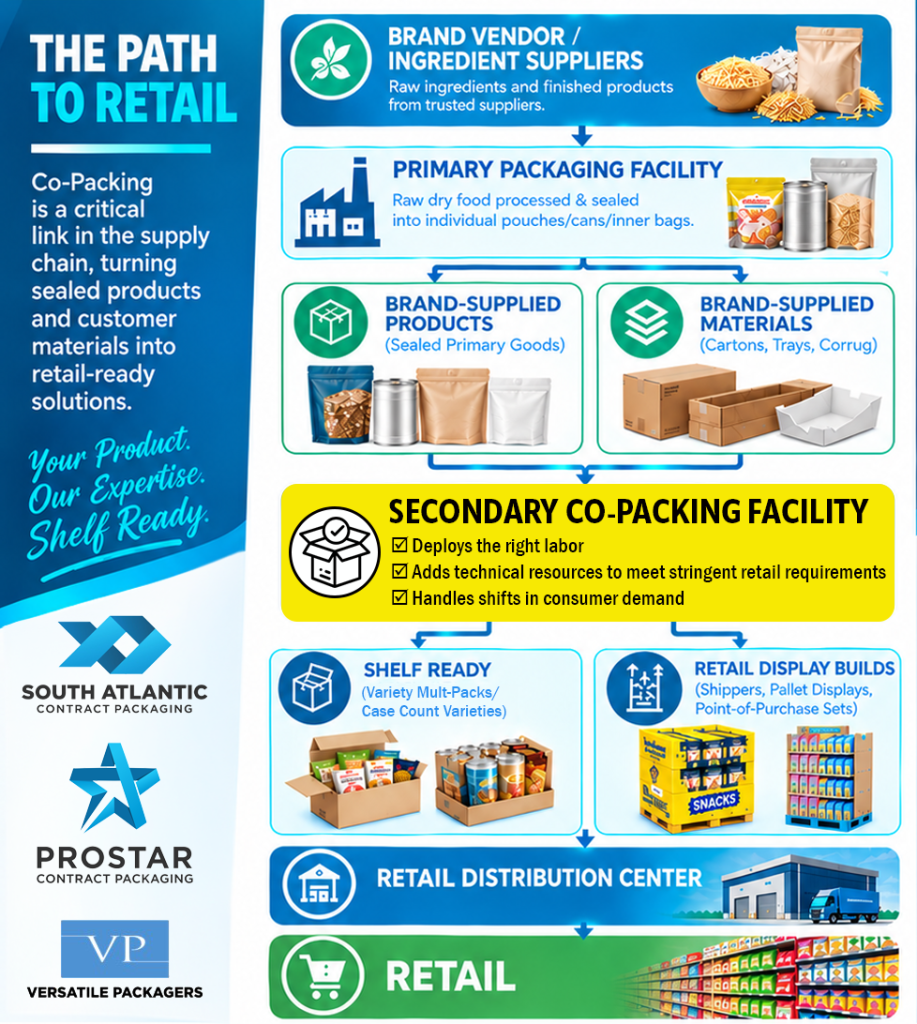
- Secondary Assembly Line: The secondary co-packer’s team prioritizes production to meet retail demands and then assigns teams of workers to physically assemble the kits, variety packs or retail display units as needed. Resources are ramped up and down based on incoming flows of inventory, which are often late arriving, and projected demand, which often varies based on shifts in consumer demand. Because the goods are already protected by primary barriers, this phase usually focuses on high-speed manual or semi-automated kitting or assembly, depending on the project requirements.
- Retail Unit Finishing: Completed variety cartons, bundles or pop-up pallet displays are serialized, coded, palletized, and shrink-wrapped to meet specific retailer receiving guidelines.
- Direct-to-Retail Logistics: The completed pallets move cleanly to the retailer’s centralized distribution hub, often ready to roll directly onto the grocery floor with zero additional handling required by store associates.
Why use Secondary Co-packer?
- To reduce capital investment and operating costs
- To align resources and cost structure with actual demand, fixing costs to a per-unit basis
- To absorb shocks to supply chains without missing deadlines
- To quickly scale and up and down to emerging opportunities and seasonal needs
- To readily shift SKU priorities across retail channels
- To gain access to specialized machinery and quality expertise